ADN Radio interviews the Commissioner
Three years after the work to identify weaknesses and propose improvements had begun, the SII is evaluating the progress. There are two most significant results. The first is the creation of the new “tax and customs” justice system, which is scheduled to go into effect starting in February 2010. The second result is the implementation of an integrated modernization project with full support of the SII employees. The project is unique in its commitment to improving the quality of service, with specific goals set for each year. Simultaneously, it makes tax controls more efficient by tailoring them to the specific characteristics of every taxpayer.
In the “Official Accounts 2008, Challenges for 2009,” Ricardo Escobar affirmed that the Tax Service has a consistent navigation chart, developed through an internal process, with full participation and support of the SII employees. The SII will be facing new professional challenges; resolving them would permit the SII to make further contribution to the modernization of the State, and, therefore, to the national development.
“At the SII, we understood that we could not go on with business as usual. Rather, the needs of the people, their professional activities, as well as the inevitable fluctuations that occur in the economy, made it imperative that we respond to new demands with creativity, building a different way of relating to one another. This new relationship takes into account the characteristics of the users of our services, and assures compliance with the tax legislation,” the Commissioner explained.
“During the 90’s, the SII had the foresight to make a significant investment into information technologies as a tool to facilitate tax compliance. One of the results of that process was the international recognition that the SII received, contributing to the prestige of the institution.
“We are certain that it is the right time for another push for modernization, and over the last three years we have defined the characteristics of the project. The definition process involved active participation at every level in our organization, from the regular employees in regional offices to the principal decision makers. The modernization project has evolved through a thorough internal debate, where ideas for modifications and improvements were exchanged. The end result of all this work is a project we call “SII Bicentennial.”
Tasks for 2006
Mr. Escobar mentioned that when he assumed the position in 2006, the Ministry of Finance entrusted him with the task of overseeing all of the primary activities of the SII. Among these was designing and promoting a law project that would result in creation of an independent tax justice system. Another task was to stimulate the process of modernization at the institution.
“The law that created the Tax and Customs courts is now a fact, and in February 2010 the new courts will begin operating in four cities: Arica, Iquique, Antofagasta and Copiapo. This process will end in 2013, when the courts will begin to operate in Valparaíso and Santiago.
The SII has always counted with the full support of the Ministry of Finance that had actively supported the SII Bicentennial project. The ministry has provided financing for each of the components of the plan and will soon be presenting a law project that will establish various incentives for the employees who are delivering measurable high quality service.”
“I truly believe we can say that today we have a navigation chart that guarantees quality and good results for the upcoming years,” the Commissioner affirmed.
A contribution to the modernization of the State
Commissioner Escobar stated that the experience accumulated by the SII throughout the process of definition of a modernization plan would be useful for implementing viable reforms at other public institutions, and, therefore, constitutes a contribution to the development of the country as a whole.
The Commissioner pointed out that during the process of reform, which would generally produce some resistance or even rejection by affected employees, it is essential to dedicate a lot of effort to internal dialogue. Every effort should be made to secure support of the entire organization, as this is a precondition of viable institutional reform.
Another aspect that was mentioned is the process of evaluating the modernization projects on part of the State that now considers each project in its entirety and not exclusively from the perspective of immediate expenses such projects would incur.
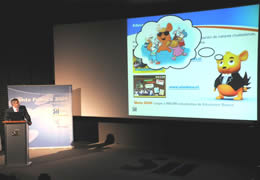
The Official Accounts were delivered in the auditorium of the Plaza de la Ciudadanía before a large mixed group composed of the government authorities, political and business leaders, representatives of the Armed Forces, members of academia and employees of the tax service.
The event was livened up by the participation of the SII mascot, Ivo the Chinchilla. The decision to incorporate Ivo the Chinchilla is seen as a sign on part of the SII of being able to adapt to changes and of seeking to create a new relationship with the taxpayer.
Challenges in evasion control
Commissioner Escobar mentioned that the international financial crisis, the general scene of contraction of global economic activity and its likely effects in Chile, constitutes a challenge for the SII in terms of crafting appropriate responses to the numerous effects of the crisis on the tax collection and public finances.
He also explained that it is tax administration’s duty to facilitate economic activities through continued reduction of the tax compliance burdens. “The point is to generate control procedures that are exact and focused, not indiscriminate. If we contacted a taxpayer about some issue months or weeks ago, and the result of the audit certified that the taxpayer was in compliance, then we should not be reviewing the very same taxpayer immediately thereafter. Rather, it would be wise to concentrate our resources on other taxpayers in greater risk of non-compliance.
In a context of predicted low economic growth or even an economic contraction, the rate of tax evasion would tend to increase and the segmented tax controls become all the more relevant. “We should be paying a lot of attention to the type of behavior that suggests lax tax compliance. To this end, we are going to apply controls that are defined by segment, i.e., in accordance with the risk of non-compliance, determined by the current situation in specific economic sectors, we will be making sure that the rate of evasion is kept under control,” Commissioner Escobar declared.
Management results 2006-2008
Referring to the results of the SII work during the 2006-2008 period, Mr. Escobar pointed out that:
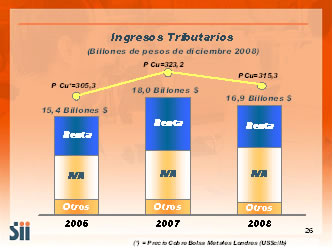
• The figure of taxes collected in 2008 was 16.9 billion pesos, which is 6% lower than the year before, this is fundamentally due to the fall experienced by the international price of copper and other metals, which led to decreased collection of the revenue tax;
• Tax filing by Internet reached 98% of the total, which means that in practical terms, participation reached its peak;
• The SII website was renovated and the “MiSII” function, whose main characteristic is the ability to provide personalized service to every taxpayer segment, was developed;
• the emission of electronic tax documentation reached 115 million documents (66% more than in 2006), today we electronically process 30% of the invoices that circulate in the country;
• The MIPYME portal for small and medium size companies. Today there are 9,500 regular users (192% increase compared to 2006). This page features partially pre-filled income tax and VAT declarations that can be submitted after a confirmation or a modification by the user;
• The electronic payments of VAT and other monthly taxes totaled $9.5 billion in 2008, 20.3% more than in 2006.
• Statistic Search System is now in operation on the SII webpage. It allows for public and private organizations, professionals, researchers and public in general, categorizing information about the number of companies and employees by region, field, economic activity and level of sales.
Commitments 2009
During 2009, the SII will continue working on the execution of its modernization project, analyzing carefully the validity of each element.
For example, in the area of new tax justice system, the SII should continue preparing to litigate in the courts that will debut in February 2010, forming and training legal teams for this effect.
The taxpayer segmentation project is being executed. The physical adaptation of the offices needs to be competed in such a way that each individual employee is able to deliver integrated assistance to every taxpayer who may require it.
In terms of the Norms Integration project, by June we are expecting to be able to deliver a new search engine that would classify and allow searches of more than 10.000 circulars, decisions and rulings related to VAT and Income Tax issues. Additional contents would be added over time, the whole being made available online to the SII employees as well as to the general public.
As far as modernizing the administration of the Real Estate Tax, we are working on acquiring a technological platform which will provide us with a digital map of the country. We will facilitate a special webpage to provide updated information to Public Notaries, Real Estate Registry officials, Municipalities, as well as property owners and those subject to Real Estate Tax.
In respect to the information management, we will be perfecting the Statistic Search System that has recently debuted; new indicators will be generated and we will continue to improve the capacity to measure distinct effects of sector-related variables.
Finally, in terms of the modernization of Human Resources policies, training efforts will be given additional importance, along with creation of leadership programs and promotion of policies oriented towards further improving the quality of work-life.