Reference Material - Advance Pricing Arrangement (APA)

What's this?
- What is an Advance Pricing Arrangement (APA)?
- Types of APA
- Advantages of entering into an APA
- Statistics (Update as of December 2025)
The Servicio de Impuestos Internos (SII) hereby presents a set of
consolidated
statistics on Advance Pricing Arrangement (APAs), with the aim of
enhancing
transparency regarding the evolution, scope, and processing status of
this
preventive instrument, which is key to providing legal and tax certainty
to
taxpayers and to strengthening cooperation between tax
administrations.
Since the entry into force of Article 41 E of the Income Tax Law in 2012
and
up to December 2025, the SII has received a total of 40 APA requests.
These
requests are classified according to their nature (unilateral,
bilateral,
or renewal), their procedural status, and the existence of import
transactions,
which require the joint participation of the National Customs Service.
In
addition, the figures presented distinguish between the historical total
of
requests received and their current processing status, thereby allowing
the
identification of both the annual inflow of new requests and the stock
of
cases under negotiation or in force.
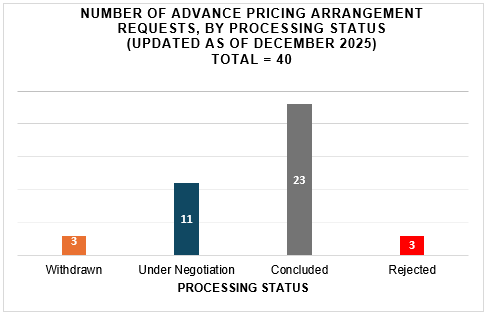
This first chart provides a detailed breakdown of the procedural status
of
APA requests received by the SII. It includes APAs concluded, requests
under
negotiation, requests rejected, and requests withdrawn, offering a
comprehensive
overview of the life cycle of this preventive instrument.
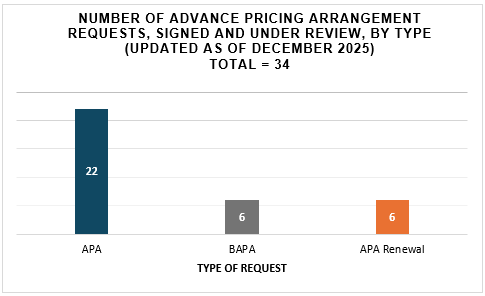
The second chart presents the distribution of Advance Pricing Arrangement (APA) requests received by the Servicio de Impuestos Internos (SII), classified according to their nature: unilateral APAs, bilateral APAs (BAPAs), and renewals of unilateral APAs. The data include only admissible requests, excluding those that were rejected or withdrawn, thereby providing an accurate depiction of the effective use of this preventive instrument by taxpayers.
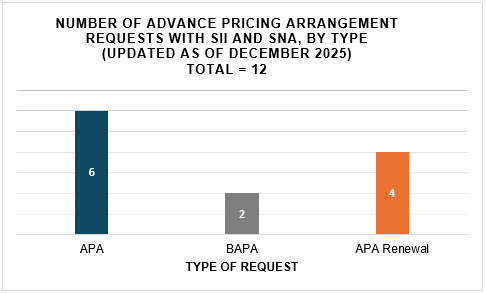
The third chart illustrates the proportion of Advance Pricing Arrangement (APA) requests that involve import transactions, which require joint negotiation and conclusion by the Servicio de Impuestos Internos (SII) and the Servicio Nacional de Aduanas. The data highlight the relevance of cross-border trade within the APAs requested and underscore the importance of inter-institutional coordination in the administration of these instruments.
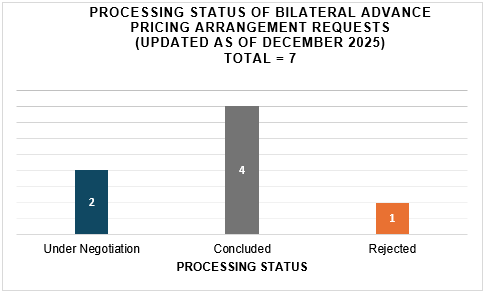
The fourth chart presents the procedural status of Bilateral Advance Pricing Arrangement (BAPA) requests, distinguishing between concluded Arrangement, requests under negotiation, and rejected requests. The jurisdictions involved in these bilateral requests include Canada, the United Kingdom, Switzerland, and the United States.
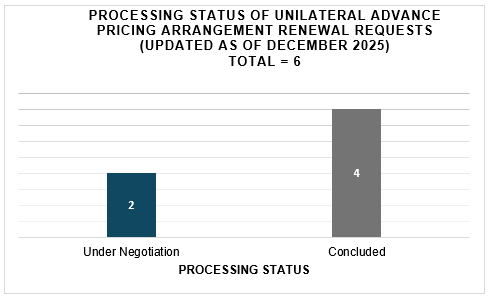
This chart presents the procedural status of renewal requests for unilateral Advance Pricing Agreements (APAs), distinguishing between concluded agreements and requests under negotiation. The information reflects the recurrent use of this instrument by taxpayers and the level of confidence generated in the APA mechanism. With respect to the six unilateral APA renewal requests received, four agreements have been concluded, while the remaining two requests are currently under negotiation, in which the Servicio Nacional de Aduanas is involved.
Evolution of Advance Pricing Arrangement (APA)
Requests
The strengthening of the Advance Pricing Arrangement (APA) programme in Chile reflects a sustained institutional strategy, which includes the establishment of a specialised technical team, the active promotion of the instrument, the implementation of document management systems, and alignment with international standards promoted by the Organisation for Economic Co-operation and Development (OECD), in particular those arising from BEPS Action 14.
The table below shows the number of requests submitted by type of Advance Pricing Arrangement:
APA Requests Received, by Type of Arrangement
| Type of Arrangement | 2021 | 2022 | 2023 | 2024 | 2025 |
|---|---|---|---|---|---|
| Unilateral APA | 4 | 3 | 5 | 5 | 3 |
| Bilateral APA (BAPA) | 1 | 3 | 0 | 1 | 1 |
| APA Renewal | 0 | 0 | 2 | 3 | 0 |
| Total | 5 | 6 | 7 | 9 | 4 |
From the table above, it can be observed that 31 out of the 40 APA
requests
submitted to the Servicio de Impuestos Internos (SII) were received over
the last six years. This represents a significant shift compared to
earlier
periods, during which an average of at least one request per year was
recorded
following the implementation of paragraph 7 of Article 41 E of the
Income
Tax Law.
In addition, 2024 stands out as one of the most productive years to date
in
terms of the number of Arrangement concluded. This trend is further
supported
by the increase in renewal requests, which reflects the confidence and
transparency
generated by these Arrangement among taxpayers and the Tax
Authority.
Based on the information available to date, more than 55% of the
requests
submitted have resulted in the conclusion of an Arrangement,
underscoring
the effectiveness of the APA programme as a preventive dispute
resolution
mechanism.
Finally, while the majority of requests have historically been
unilateral
APAs, bilateral requests are expected to gain greater relevance in the
coming
years, given that Chile has 37 tax treaties in force for the avoidance
of
double taxation, including the most recent treaty with the United
States.
These treaties enable the negotiation and conclusion of Bilateral
Advance
Pricing Arrangement (BAPAs), which constitute a highly effective tool
for
preventing economic double taxation.